
The FCICM Short Answer Questions (SAQs) are the crucible of the entire FCICM exam and the rate-limiting step in progressing forward. This blog will show you how to win each one, 10 minutes at a time.
Table of Contents
The Challenge: 15 Questions. 2.5 Hours. No Room for Error.
The FCICM written paper is not a test of intelligence, nor is it an English Literature exam— it’s a test of structure, clarity, and clinical maturity. You’ll face 15 SAQs in 2.5 hours, with 10 minutes reading time and no margin for delay.
You’re not writing essays. You’re showing examiners that you think like a consultant: fast, focused, and clear under pressure.
Know the FCICM SAQ Game
Understanding the FCICM Written Exam
CICM questions are precise. Each word in the question matters. Examiners have painstakingly reviewed each word to ensure clarity and purposeful content. Each word carries its weight and holds meaning. Understanding the terminology is half the battle. The other half is answering the question specifically, without being vague or misinterpreting it, which is a common pitfall for past trainees.
| Definition | What It Means | Strategy |
| Critically Evaluate | Explain evidence | 2-liner evidence to support clinical understanding. Use RADES |
| Outline | Broad summary of key points | Headers + sub-headings + bullet points |
| List | Simply list. | If possible, prioritize and organise |
| Compare and Contrast | Tabulate differences | Aim to highlight differences or similarities |
| Assessment | Hx + Ex + Ix | Focus on structure |
| Management | Use your/college templated structure | Focus on structure |
| Discuss | Explain key principles | Use RADES + controversies |
| Explain | Detailed explanation | Heading + sub-headings + bullet points |
🔑 Tip: Use past examiner reports to calibrate your answers. RADES: Rationale-Adv-Disadv-Evidence-Statement Summary
Structure: Bullet Points Are the Currency of Marks
Imagine this: you’re an examiner reviewing 45 papers at 10 p.m.
Do you want to read a page-long paragraph, or scan well-labelled bullet points with headings?
The bullet point is the basic expression of the written exam – Arvind Rajamani, Examiner and Intensivist
✅ Correct approach:
Management of septic shock:
- IV fluid resuscitation with 30 mL/kg crystalloids
- Early vasopressor (norepinephrine) if MAP <65 mmHg
- Empirical antibiotics within 60 minutes
Structure = focused and organised approach. Use:
- Headings
- Bullet points
- Prioritised lists
- Frameworks (e.g., VINDICATE)
The 10-Minute Rule for the FCICM exam: Time is Everything
- One FCICM SAQ = 10 minutes. No exceptions.
- If you go over, you rob yourself of marks from the next one.
- Set a watch or analog timer. Time every question during practice.
- Train weekly: Do 15 SAQs in 2.5 hours. No breaks.
Statistically, you cannot pass the exam if you leave ONE question unanswered.
Strategy:
- I recommend starting from question 1 to 15 to ensure you don’t miss any questions under time pressure.
- I highly recommend using the 10 minutes reading time to:
- First skim the questions to have a general overview.
- Then plan Question 1 out in you mind.
- This will help you start on a solid and confident ground which will translate to the rest of the exam paper.
- Some use the reading time to analyse data interpretation question and answer them immediately to save time overall.
- However the data interpretation questions are becoming more complex and actually do take time.
- The pragmatic goal = get your 6/10 and then move on.
Handwriting: Practise Like It’s 1995
Yes, it matters.
Good ideas get zero marks if they’re unreadable. Examiners won’t decipher scribbles.
Tips:
- Use non-smudging, black or blue ballpoint pens
- Write clearly, upright, with space between points
- Practise daily by hand — even one SAQ a day helps
Write With Maturity: Think Like a Consultant
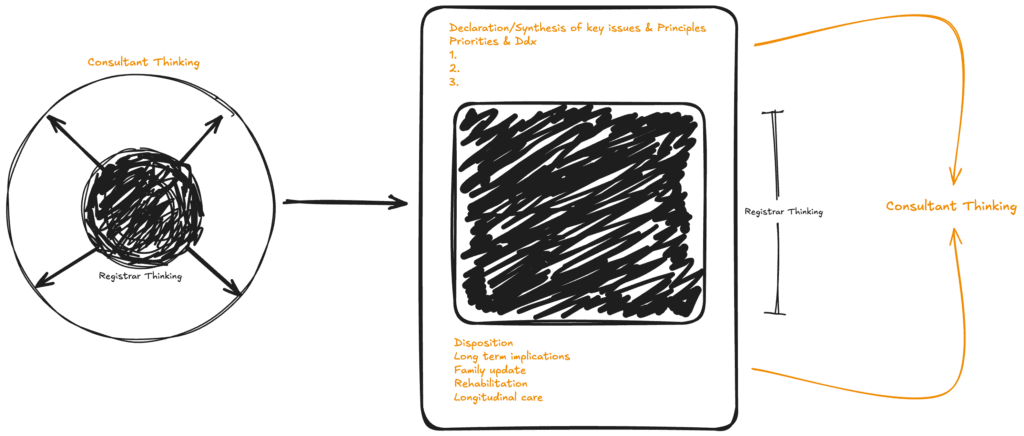
Examiners are looking for signs of seniority in your answers. This doesn’t mean more knowledge — it means better judgment.
Compare:
❌ Immature: “I might consider maybe giving some antibiotics…”
✅ Mature: “Administer empirical broad-spectrum antibiotics within 60 minutes (e.g. piperacillin-tazobactam)”
Show prioritisation, decisiveness, and intent.
This is a consultant exam. So you must think like a consultant, not a registrar. Reframe your mindset daily with the following affirmation from the day you start preparing – ‘I AM AN ICU CONSULTANT’.
The Tools That Make You Sharp
| Tool | Why It Helps |
| Analog Watch | Practise for exam day – CICM doesn’t allow digital timers |
| Past Papers & Examiners Reports | Learn what get marks |
| Anki | Reinforce recalls of frameworks |
| Calculator | For data calculations |
| Notion/Second Brain | Organise your frameworks and notes for lifelong learning |
🔑 Tip: Don’t forget your calculator!
Common Mistakes That Kill Marks
- ❌ Writing a brilliant answer… to the wrong question
- ❌ Spending 20 minutes on one question = two blanks. Suicide!
- ❌ Paragraphs instead of dot points
- ❌ Illegible writing
- ❌ No headings, structure or targets
- ❌ Not understanding the command word
Exam Day Mindset
- You’ve trained for this. Stay calm.
- Have a plan:
- First pass: All questions chronologically
- Second pass: Revisit flagged ones
- Don’t get emotionally attached to any one answer
- Hydrate, take deep breaths to recalibrate, and stretch briefly at the halfway mark
- Stay in the zone during lunch break. For example, go for a walk, eat alone, or listen to music. This is not the time to discuss questions or engage in conversations that could trigger or emotionally distract you.
Summary Checklist: How to Conquer the Written Exam
✅ Use bullet points and headings
✅ Stick to 10 minutes per SAQ
✅ Practise with past papers and timed runs
✅ Learn the command terms
✅ Make your handwriting exam-ready
✅ Use mature clinical tone
✅ Don’t stop — keep moving
💎 Bonus
Check out my FCICM Resources page for all the prep material and resources you need!
Also, if you need some ancient wisdom about overcoming mental and emotional barriers in approaching this exam, you can just read more here.