The FCICM Hot Case doesn’t end when you put your stethoscope down. In many ways, this is where the performance is judged most sharply—your ability to communicate clearly, present a structured summary, and leave the examiners with confidence in your clinical reasoning. This post dives into how to phrase your presentation and how to close with strong final impressions.
Table of Contents
Why Presentation Matters
- Examiners already know the patient—they are testing your synthesis, prioritisation, and clarity.
- A scattered or rushed presentation can undermine a solid examination.
- Clear, confident phrasing shows maturity and consultant-level readiness.
The Structure: A Simple Framework
Think of your presentation as a three-act structure:
- Opening line (the elevator pitch)
- Sets the tone.
- Example: “This is a 65-year-old gentleman on Day 3 post-CABG who remains ventilated with ongoing haemodynamic instability and new renal dysfunction.”
- Answer the question within the first 30 seconds of your opening line. Example: ” This is a moribund patient in multiorgan failure with the following key issues: 1. Respiratory Failure 2. Cardiac failure and 3. Critical illness weakness
- DO NOT START BY PARROTING THE QUESTION AGAIN
- Avoid phrases like: I was asked to see….I had the pleasure to see…..It was wonderful to see, or worst (Repeat the whole stem and question). This is painfully repetitive for the examiners who are examining multiple candidates, and also robs you time to demonstrate your clinical findings and acumen.
- Remember, your first impressions will impact your likelihood of success significantly.
- Core summary (the key findings)
- Group by systems, but prioritise what is critical and abnormal.
- Use crisp phrases:
- Respiratory: “He is intubated on volume control with FiO₂ 0.5 and PEEP 8, with good oxygenation but limited compliance.”
- Cardiovascular: “He is vasopressor-dependent on noradrenaline 0.12 µg/kg/min with cool peripheries, elevated JVP, and bibasal crackles.”
- Other systems: Keep concise but don’t neglect neuro, renal, GI, lines, wounds.
- Closing line (your synthesis + impression)
- Tie it together in one or two sentences.
- Example: “In summary, this is a critically unwell post-cardiac surgery patient with cardiogenic shock and evolving multi-organ dysfunction. My main concerns are haemodynamic instability, fluid balance, and potential graft dysfunction.”
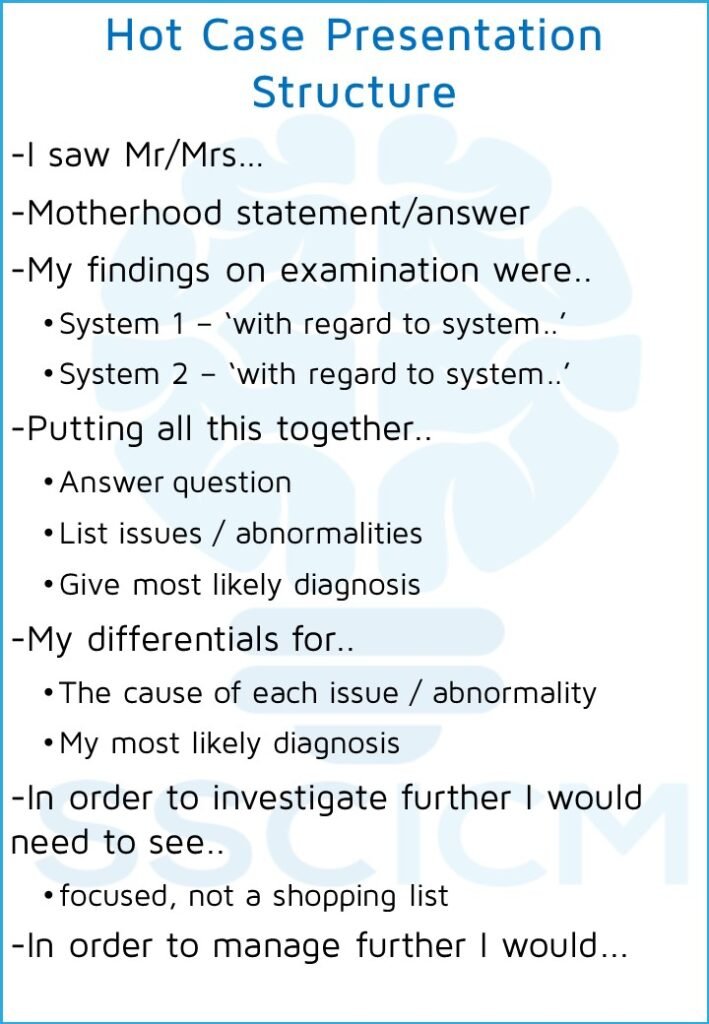
A Suggested FCICM Hot Case Structure
I shamelessly stole this from the Sydney Short Course in Intensive Care Medicine website for you to take a look at. Check out their website for other essential resources like the CICM Written SAQs Examples using the CICM College glossary.
I personally drilled these phrases into my presentation and found it immensely useful, allowing my presentation to flow fluently with confidence. I recommend rote learning and practising the opening lines, and then filling in the information you acquired from the examination.
Also, their course is excellent (I attended it in 2024) and I would recommend it.
Phrases That Convey Maturity
Examiners listen for phrases that sound consultant-ready:
- For uncertainty:
- “This could represent either sepsis or cardiogenic shock—further data will clarify.”
- “I am concerned about this finding and would escalate monitoring.”
- For prioritisation:
- “The most urgent problem is…”
- “The primary…The pertinent…”
- For balance:
- “On the one hand… however, on the other hand…”
- “My impression is cautiously optimistic given current stability.”
- ‘This case is challenging due to the competing clinical interest…”
- For final impressions:
- “If stable, I would aim for a trial of extubation in the next 24 hours.”
- “If deterioration continues, I would escalate to mechanical circulatory support.”
Common Pitfalls in Presentation
- Overloading detail: Listing every lab or ventilator parameter instead of synthesising.
- Failure to prioritise: Spending too long on non-critical systems.
- Vague closing: Ending with “that’s all” instead of a strong impression.
- Lack of confidence: This is often demonstrated by concise language that synthesizes the question with the ability to justify your decision-making. Say more by saying less.
Final Impressions: The Consultant’s Seal
This is your chance to leave the room on the front foot. Think of it as your consultant sign-off:
- Short, clear, confident.
- Focused on trajectory and plan.
- Avoid speculation—be measured.
Example:
“This patient remains critically unwell with probable septic shock on a background of multi-organ dysfunction. The immediate priorities are haemodynamic resuscitation, source control, and reassessment of organ support. I would review progress closely over the next few hours, anticipating the need for escalation if instability persists.”
Take-Home Messages
- Start strong immediately: a one-line summary hooks the examiners.
- Stay structured: abnormal, critical, synthesised.
- Sound like a consultant: prioritise, be balanced, end decisively.
- Final impressions matter: they are your lasting footprint.
✅ Next in the series: Part 3 – Handling Examiner Questions and Staying Composed Under Pressure.
💎 A Note on Public Speaking
I understand this can be very scary. Speaking in public, let alone speaking in front of an audience that is scoring you for being able to convey confidence, information, and recollect examination findings and tying them all up in nice headings, sub-headings, and conclusions. It’s a lot.
But…
You want to pass. You need to pass. And so…
Practise is the only way you are going to harness the mettle to become a poised, confident, eloquent, concise, and experienced speaker.
Practise daily. In the shower. In the mirror. In front of your family, spouse, and dog.
For inspiration and learning technical skills to improve your vocal image and build presentation mastery, I highly recommend visiting Public Speaking and Communication Expert Vinh Giang’s YouTube page for excellent content.
I used one of his many techniques, which I recorded myself on my iPhone, presenting a hot case and listened back thrice:
- First with video and audio
- Then, with video only (on mute): To observe hand and face visuals
- Then, with voice only (no video): To learn my voice intonation, rate, pronunciation and enunciation.
This one technique itself gave me more insight into my presentation than any other tool. Safe to say my mastery progressed from there forth.
If I can do it, so can you.
You got this!
💎 Resources
If you haven’t done so, check out my:
Ultimate Resources Page for all of the best resources to equip your studying journey, or Mastering The FCICM Hot Case – Part 1: Outside The Door and Into The Dance for starting your hot case plan of attack on the right foot.