
How to use Perplexity, ChatGPT, Claude and NotebookLM to pass the FCICM exam — without burning out
The Four Tools Worth Your Time
Table of Contents
You are sitting in the ICU at 2 am between patients, twenty minutes of quiet in front of you, FCICM exam six months away, and you open your phone. What do you actually do with it?
Most trainees still scroll Instagram or, at best, open a PDF they have read three times already. But the clinicians passing the FCICM in 2026 are doing something different. They are using AI — not as a novelty or to cheat, but as a precision study tool. The question is not whether to use it. The question is which tool to reach for, and when.
This post is not a generic AI tutorial. It is a practical playbook built specifically for FCICM candidates, drawing on how these tools perform under the actual demands of the exam’s written and viva components.
The Four Tools Worth Your Time
There are dozens of AI assistants available. Most is noise. For FCICM preparation, three tools stand out — and they are not interchangeable.
Think of them like this: Perplexity is your literature scout. ChatGPT is your tutor. NotebookLM is your librarian. You would not send your librarian to a journal club or your tutor to pull references. The same logic applies here.
1. Perplexity: Your Literature Scout
Perplexity is a search-native AI. Every answer it provides includes inline citations to primary sources — guidelines, NEJM papers, and UpToDate summaries. This is its defining feature and superpower for exam preparation.
Best use cases:
- Rapidly summarising evidence for a topic (e.g. “What does current evidence say about balanced crystalloids vs saline in ICU patients? Cite the primary RCTs”)
- Confirming guideline thresholds and clinical cut-offs before writing an SAQ
- Fact-checking your own notes against current literature
- Finding recent papers on emerging topics such as awake prone positioning or AI-assisted monitoring
- Building a reading list on a weak topic — Perplexity can surface the five most relevant papers in sixty seconds
The honest limitation:
Perplexity does not reason deeply. It retrieves and synthesises, but if you ask it to explain the pathophysiology of ARDS or walk you through a viva on vasopressor choice, it will underperform. It is a scout, not a tutor. Use it to find the evidence, then take that evidence into ChatGPT to learn it.
| Perplexity Prompt That Works: Summarise the ADRENAL and VANISH trials in three bullet points each. What did each trial conclude about corticosteroids in septic shock, and what is the current SCCM/SSC position? Cite the primary publications.” |
2. ChatGPT: Your Personal Tutor
ChatGPT is the most versatile of the three tools. It has the strongest reasoning, the best instruction-following, and — critically for FCICM — the ability to simulate the interactive, high-pressure environment of a viva.
Best use cases:
- Viva simulation: “You are an FCICM examiner. I am a candidate. Conduct a viva on ventilator management in ARDS. Be demanding. Do not give me the answer until I have attempted it.”
- SAQ answer drafting and critique: Write a practice SAQ answer, then paste it and ask ChatGPT to mark it against typical examiner criteria — clinical accuracy, structure, completeness
- Pathophysiology deep-dives: ChatGPT can explain multi-system pathophysiology in a layered, dialogue-based way that a textbook cannot
- Topic mapping: “Give me a comprehensive list of FCICM exam topics grouped by organ system, ranked by frequency of appearance in past papers”
- Generating custom SAQ questions on your weak areas
- Creating infographics and concept maps: Paste a complex concept and ask for a structured diagram or flowchart — ChatGPT with image generation can produce useful visual summaries of pathophysiology
- Timed practice: “Give me an SAQ. I have eight minutes. Tell me when to stop.”
The honest limitation:
ChatGPT hallucinates. It can confidently cite a trial that does not exist or give you a drug dose that is slightly wrong. Never use a ChatGPT answer as your sole source for a clinical fact. Always cross-reference with Perplexity (which will give you a real citation) or a primary guideline. The two tools are strongest when paired.
| ChatGPT Prompt That Works: “I want to practice the FCICM viva. Act as an examiner. Start with: ‘A 55-year-old with severe community-acquired pneumonia has been intubated and is on 60% FiO2 with a P/F ratio of 110. What do you want to do?’ Do not give me feedback until I have finished my response. Be as direct as a real examiner.” |
3. NotebookLM: Your Personal Librarian
NotebookLM differs from the other two in a fundamental way: it works only with sources you upload. It cannot access the internet. It will not invent facts. Everything it tells you is traceable, sentence by sentence, to a document you provided. For an evidence-driven exam like the FCICM, that is a significant advantage.
Best use cases:
- Upload your ICU textbooks, LITFL summaries, deidentified personal notes, or downloaded guidelines — NotebookLM will answer questions grounded only in those sources
- Generating a comprehensive study guide from uploaded material — ask it to create a structured overview of mechanical ventilation from your uploaded Marino and Tobin chapters
- Creating flashcards and quizzes from your own notes — it can generate hundreds of question-answer pairs from your uploaded documents
- Audio overviews: NotebookLM can generate a ten-minute podcast-style audio summary of your uploaded sources — ideal for driving or commuting between FMC and home
- Source-grounded Q&A: “Based only on the ANZICS guidelines I have uploaded, what is the recommended approach to ICU family communication?”
- Cross-document synthesis: Upload five papers on a topic and ask NotebookLM to compare and contrast their conclusions — it will cite exactly which paper each point comes from
The honest limitation:
NotebookLM is only as good as what you upload. If you upload mediocre sources, you will get a mediocre synthesis. Curate carefully. Start with ten to fifteen high-quality sources per topic rather than dumping everything you have. And it cannot help you practice for the viva — that is ChatGPT’s territory.
| NotebookLM Prompt That Works “I have uploaded the ANZICS Critical Care Resources position statement and the ACCCN standards. Create a structured comparison table of the key recommendations, with one column per document. Then generate ten quiz questions that test the key differences.” |
4. Claude: Your Study Partner
Claude is different from ChatGPT in ways that matter for exam preparation. Where ChatGPT is an agent optimised for task execution, Claude is optimised for reasoning, nuance, and long-form document analysis. The 200,000-token context window in Claude Projects means you can upload an entire textbook chapter, a set of guidelines, and your own notes — and have a genuine, sustained dialogue about all of it in one sitting.
More usefully for FCICM candidates: you can build a persistent Claude Project configured specifically as an FCICM study partner. Set it up once with a detailed system prompt outlining your exam structure, your weak areas, and your preferred teaching style. Every subsequent session picks up with that context intact.
Best use cases:
- Building a dedicated FCICM Project: upload your curriculum, weak-topic notes, and past SAQ answers — Claude retains this context across sessions and uses it to personalise responses
- Deep document reasoning: paste a complex guideline or paper and ask Claude to explain its clinical implications, challenge its methodology, or connect it to a related SAQ topic
- SAQ answer critique with genuine depth: Claude will not just tell you the answer is incomplete — it will explain the reasoning behind examiner expectations and suggest how to restructure your argument
- Pathophysiology as dialogue: unlike a textbook, Claude can meet you at your level, slow down on the parts you find confusing, and use analogies drawn from your clinical experience
- Comparing your reasoning to expert reasoning: describe your clinical decision-making on a case and ask Claude where your logic holds and where it breaks down
- Writing and structuring SAQ answers: Claude is particularly strong on prose quality and argument structure — useful for candidates whose content knowledge is solid but whose written expression under time pressure is not
The honest limitation:
Claude does not have real-time web access in the standard interface, so it cannot pull current guideline updates or recent trial results the way Perplexity can. For anything time-sensitive, verify with Perplexity first. Claude is also not a viva simulator in the same instinctive way ChatGPT is — it tends toward thoughtful explanation rather than rapid-fire examiner pressure. Use both.
| Claude Prompt That Works “I am an FCICM candidate with six months until the exam. My weakest area is renal replacement therapy — specifically the nuances of anticoagulation choice and timing of initiation. I have uploaded the KDIGO AKI guidelines and two RCTs. Teach me this topic as if you were a consultant running a bedside tutorial. Start by asking me what I already know.” |
Which Tool for Which Task?
Use this as your quick-reference guide when you sit down to study:
| Task | Perplexity | ChatGPT | NotebookLM | Claude |
| Literature search with citations | ★★★ Best | ★★☆ Good | ★☆☆ Not designed | ★★☆ Good |
| Topic mapping & gap analysis | ★★☆ Good | ★★★ Best | ★★☆ Good | ★★★ Best |
| Explaining pathophysiology | ★★☆ Good | ★★★ Best | ★★☆ Good | ★★★ Best |
| Generating SAQ questions | ★☆☆ Limited | ★★★ Best | ★★☆ From your notes | ★★★ Best |
| Viva simulation & rehearsal | ★☆☆ Limited | ★★★ Best | ★☆☆ Not designed | ★★☆ Good |
| Synthesising uploaded resources | ★☆☆ Limited | ★★☆ Good | ★★★ Best | ★★★ Best |
| Audio podcast from notes | ★☆☆ No | ★☆☆ No | ★★★ Best | ★☆☆ No |
| Guideline fact-checking | ★★★ Best | ★★☆ Good | ★★★ From uploads | ★★☆ Good |
| SAQ answer critique & coaching | ★☆☆ Limited | ★★☆ Good | ★☆☆ Limited | ★★★ Best |
| Infographic / concept map | ★☆☆ Limited | ★★★ Best | ★★☆ Good | ★★☆ Good |
★★★ = Best tool for this task ★★☆ = Good ★☆☆ = Limited or not designed for this
A Practical Study Workflow
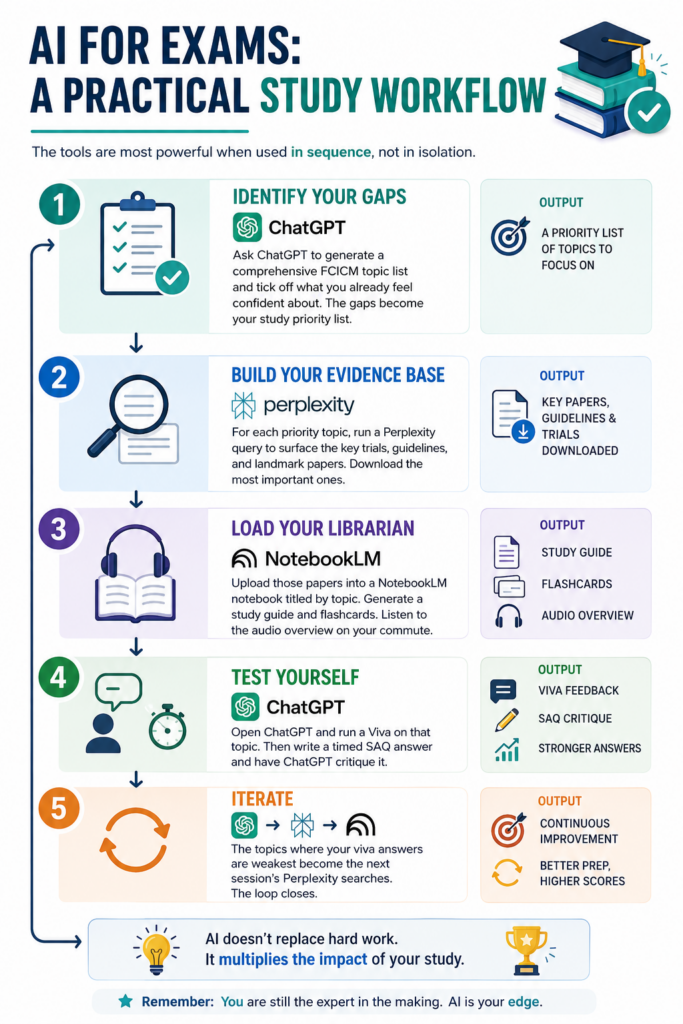
The tools are most powerful when used in sequence, not in isolation. Here is a workflow that works:
Step 1: Identify your gaps. Ask ChatGPT to generate a comprehensive FCICM topic list and tick off what you already feel confident about. The gaps become your study priority list.
Step 2: Build your evidence base. For each priority topic, run a Perplexity query to surface the key trials, guidelines, and landmark papers. Download the most important ones.
Step 3: Load your librarian. Upload those papers into a NotebookLM notebook titled by topic. Generate a study guide and flashcards. Listen to the audio overview on your commute.
Step 4: Test yourself. Open ChatGPT and run a Viva on that topic. Then write a timed SAQ answer and have ChatGPT critique it.
Step 5: Iterate. The topics where your viva answers are weakest become the next session’s Perplexity searches. The loop closes.
One Thing AI Cannot Do
None of these tools can replace deliberate, effortful thinking. The research on medical exam preparation is consistent: active recall and spaced repetition are the highest-yield study methods. AI amplifies both—ChatGPT enables active recall through Viva simulation, and NotebookLM enables spaced repetition through custom flashcards. But you still have to do the thinking.
AI also hallucinates. Every clinical fact you intend to use in an SAQ should be verified against a primary source. These tools will accelerate your learning — they will not make it effortless, and they should not.
The FCICM is a test of clinical judgment under pressure. Use AI to sharpen your knowledge base. The judgment is still yours.
The Bottom Line
FCICM candidates who use AI well are not cheating. They are studying smarter. The trainees who will struggle are those who either ignore these tools entirely or use them passively — reading ChatGPT summaries rather than testing themselves against it.
Perplexity for evidence. ChatGPT for simulation. NotebookLM for synthesis. Run them in sequence, not isolation. And remember: the exam is not asking whether you have read the papers. It is asking whether you can think with them.
Start there.
If you need references, check out The Ultimate Resource Guide for the FCICM Fellowship Exam
If you need to prepare with the Fellowship Written Preparation, start with How to Prepare for the FCICM Fellowship Exam: The Setup Most People Skip
For more insightful advice to give you an unfair advantage, cutting through all the noise and offering you crystal clear clarity on your exam journey, join my newsletter below and get the best podcast resources in your inbox, stat.
I have also started the FCICM Exam Accelerator Academy – a personalised 1-on-1 coaching programme that applies everything I teach in an organised, strategic manner to take you from where you are to exam-ready in 3 weeks!
DM me on LinkedIn for a 45-min coaching call to see if you qualify for the Academy. See you on the inside!
As always, you got this! 💪🏼